Rung & Bill!
Rung Sangprasit's & Bill Smart's Personal Website
US Electoral College
...an opinion piece written by Bill Smart
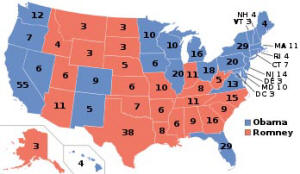 |
This opinion piece proposes two major
changes to the present Electoral College system which is
used in the United States to elect a president and
vice-president.
I assume the reader is at least somewhat familiar with that
system and don’t attempt to explain it here.
If the reader is unfamiliar with or wants to refresh
their knowledge of that system, they should do so before
reading further.
A good source of information on the Electoral College
can be found at
Electoral College (United States) - Wikipedia.com. |
The two major changes to the present Electoral College system I propose concern the amount of electoral votes each state is granted and the way each state apportions their electoral votes to candidates.
Amount of Electoral
Votes Currently, the amount of electoral votes
each state is granted is equal to the number of members of
Congress of that state.
These numbers are determined by the latest U.S.
Census which is done every ten years, the last one in 2010. I propose that instead, the amount of
electoral votes for each state be apportioned by the amount
of people who cast votes for the president in that election
compared to the total votes cast nationwide.
This would have two effects.
Firstly, it would adjust the voting power of the state
to be in direct proportion with the citizens of that state
who cared enough to vote.
Secondly, it would act as an inducement for a state
who wishes to have influence on the
election to encourage voting rather than making laws that
discourage or even prevent some citizens from voting.
I believe in today’s computer age, this calculation
could be done in real-time on the votes cast in the current election, but if
that is thought to be problematic, the voting totals of the previous
election could be used.
Apportionment of
Electoral Votes to Candidates |
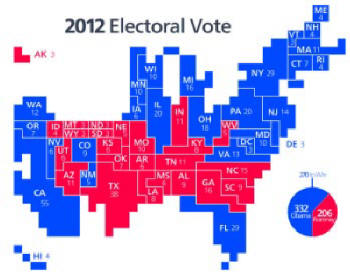
| I propose that the states themselves be required to distribute their electoral votes proportionately to the candidates depending on their vote totals for each candidate instead of the “winner take all” award that all but two states now use. There would have to be rules about how fine the apportionment would be, but I’d recommend starting with the candidate garnering the most votes, determine his/her percentage of the total votes of that state, apportion that to the number of the state's electoral votes, rounding up to the nearest whole number of electoral votes. |
 |
| And just for the record, what I’d most
prefer is to have our president/vice-president elected
purely democratically in a nationwide election where each
vote counts as much as every other. Copyright © 2016 Bill Smart. All rights reserved. Reproductions permitted. * * * * * * The following was added in September, 2017, after the election of Donald Trump: As I stated just above, my preference is to do away with the Electoral College and go with a purely democratic election. Anyone who's eligible could run or be written-in during the general election. If one candidate pair does not get a majority in the general election, a run-off election should be held within a month in which only the first two candidate pairs are on the ballot. Only votes for one of these will be counted. Other votes, such as write-in's, will be discarded and not count in the vote total. The candidate pair getting the most votes in this run-off election will be declared the victors. |
* * * * * *
Copyright © 2017 Bill Smart. All rights reserved. Reproductions permitted.